 How-to
How Data Feed Quality Impacts Trade Execution
Last Updated: November 15, 2026
Quick Summary
Data feed quality is the measure of how accurate, complete, and timely a stream of market prices is when it reaches your platform, and it decides whether your entry fills where you intended or somewhere worse. Latency, stale quotes, and gaps turn into real execution costs like slippage and execution shortfall, so you should audit your feed before trusting it with real decisions.
- Feed latency has three main causes: transmission speed, processing time inside your software, and order routing.
- Latency costs more as order size grows, so measure slippage by order size bucket rather than as a single average.
- Direct feeds offer lower latency for one venue, while consolidated feeds give fuller depth across fragmented markets.
- Set alerts for quote gaps and latency spikes, pause new orders when the feed is suspect, and cross-check a second source.
- Run a feed-quality audit quarterly and again after any platform change.
Table of Contents
- Why Data Feed Quality Decides Trade Execution Outcomes
- Market Data Feed Latency and Its Effect on Fill Prices
- How Stale Market Data Creates Execution Shortfall
- Direct vs. Consolidated Market Data Feeds
- Market Data Feed Monitoring and Incident Response
- A Practical Feed-Quality Audit Checklist
- Choosing a Data Feed Setup That Matches Your Trading Style
- Frequently Asked Questions
Why Data Feed Quality Decides Trade Execution Outcomes
Every order you place depends on the prices you see first. When the underlying data feed is wrong, late, or incomplete, your trade executes against a market that no longer exists. That gap between what you saw and what you got is where good strategies quietly die.
Data feed quality is the measure of how accurate, complete, and timely a stream of market prices is when it reaches your platform. It decides whether your entry fills where you intended or somewhere worse.
A trader can follow every rule and still lose to a delayed quote.
Below, we break down how feed problems turn into real execution costs, and how to audit your own setup before they do.
Market Data Feed Latency and Its Effect on Fill Prices
Market data feed latency is the delay between a price change at the exchange and that change appearing on your screen. Even small delays move the price you actually get, and the effect compounds when you size an order against a quote that is already gone.
Consider a simple case. You see a quote at a given level and send a buy order. By the time it reaches the market, sellers have stepped away. Your order fills higher than planned. The difference is slippage, and latency is one of its main causes.
Three things widen that gap:
- Transmission speed between the exchange and your platform
- Processing time inside your trading software
- Order routing from your platform to the execution venue
A common mistake is blaming the broker for every bad fill. Often the delay started upstream, in the data itself.
Separating feed latency from routing and volatility
Slippage is the sum of several effects, and feed latency is only one of them. To measure the feed's contribution, hold the other variables still. A practical approach is a controlled comparison: record the timestamp on the exchange update, the timestamp when your platform displays it, and the timestamp when your order reaches the venue.
Define the metrics before you compare. Common ones include:
- Quote-to-screen delay: exchange timestamp minus display timestamp, measured in milliseconds
- Decision-to-venue delay: order-send timestamp minus venue-receipt timestamp
- Effective spread paid: fill price minus the midpoint at the moment the order was sent
- Realized slippage: fill price minus the quote you acted on, signed against your direction
Run the same strategy on a quiet day and a volatile day. If realized slippage grows faster than effective spread, the extra cost is likely feed-driven rather than a routing or strategy effect.
Watch out: comparing fills across different order sizes or market conditions will mix feed effects with liquidity effects, so keep size and time window constant when you isolate the feed.
SEC guidance on market data and order routing
What latency does to fill prices at different order sizes
Latency costs more as order size grows. A small order can often fill at or near the displayed quote even after a short delay. A larger order may sweep several price levels, and each level it reaches was quoted at a moment that has already passed.
This is why two traders on the same feed can report different experiences. The one trading smaller size sees a tolerable delay; the one working larger size sees the same delay as a material cost. When you audit your own setup, measure slippage by order size bucket, not as a single average, so the feed's effect on your actual trading is visible.
How Stale Market Data Creates Execution Shortfall
Stale market data is a price that looks current but is not. The quote on your screen lags the true market, so every decision built on it is one step behind.
Execution shortfall is the total cost of that gap: the difference between the price you expected and the price you received, across an order. It grows with order size.
Watch out: traders often read shortfall as bad luck. In practice, a repeated pattern of worse fills on fast-moving days points to a feed problem, not a run of poor timing.
The fix starts with better stop placement. Our guide on volatility stop losses using ATR shows how to set them.
Direct vs. Consolidated Market Data Feeds
Direct and consolidated feeds differ in where the data comes from. A direct feed connects you to a single exchange or venue. A consolidated feed pulls quotes from many venues into one stream.
That choice shapes what you see. Direct feeds are typically faster for one venue. Consolidated feeds give a fuller picture of liquidity and market depth across fragmented markets.
| Feed Type | Strength | Trade-off | Best For |
|---|---|---|---|
| Direct | Lower latency, venue-specific depth | Narrow view of the market | Single-venue, speed-focused strategies |
| Consolidated | Full depth across venues | Slightly higher delay | Multi-venue and liquidity-sensitive trades |
Market fragmentation makes this decision matter. When liquidity is split across venues, a consolidated view helps you judge true market depth before you size an order.
Matching the feed to your trading setup
Feed quality is not one-size-fits-all. The right choice depends on what you trade and how you route orders.
- Retail equities and ETFs: a consolidated view is usually the practical default because liquidity is spread across many venues and the retail order flow is often routed to a wholesaler. Prioritize completeness and symbol mapping over microsecond latency.
- Futures: many contracts trade on a single dominant venue, so a direct feed for that venue often gives the cleanest depth and the lowest delay. Cross-venue arbitrage or spread strategies still need a consolidated view of the related contracts.
- Institutional equities: direct feeds from the main venues plus a consolidated reference are common, because execution algorithms need both venue-level depth and a full-market picture to route intelligently.
- Fixed income: much of the market is quote-driven and fragmented, so consolidated data and careful vendor evaluation matter more than raw speed. Coverage and timestamp consistency are the deciding factors.
The total cost trade-off
Faster feeds and broader coverage usually carry higher fees, and the fees are only part of the cost. Add infrastructure, bandwidth, and the processing power needed to normalize and store the stream. Weigh that total against the execution benefit for your order sizes and holding periods. A scalper working large size may justify the spend on a low-latency direct feed; a swing trader holding for days may get more value from complete consolidated data and a reliable vendor than from shaving milliseconds.
Watch out: choosing a feed on headline latency alone can leave you with fast data for one venue and a blind spot everywhere else, which is a worse outcome than a slightly slower but complete stream.
Vendor evaluation questions
Turn the choice into a procurement process. Ask each provider for its update frequency, its failover and redundancy arrangements, how it handles symbol changes and corporate actions, and how it documents outages. Request a sample of historical data and compare it against an independent source before you commit. A provider that cannot answer these questions clearly is a risk to your execution, not just your budget.
Market Data Feed Monitoring and Incident Response
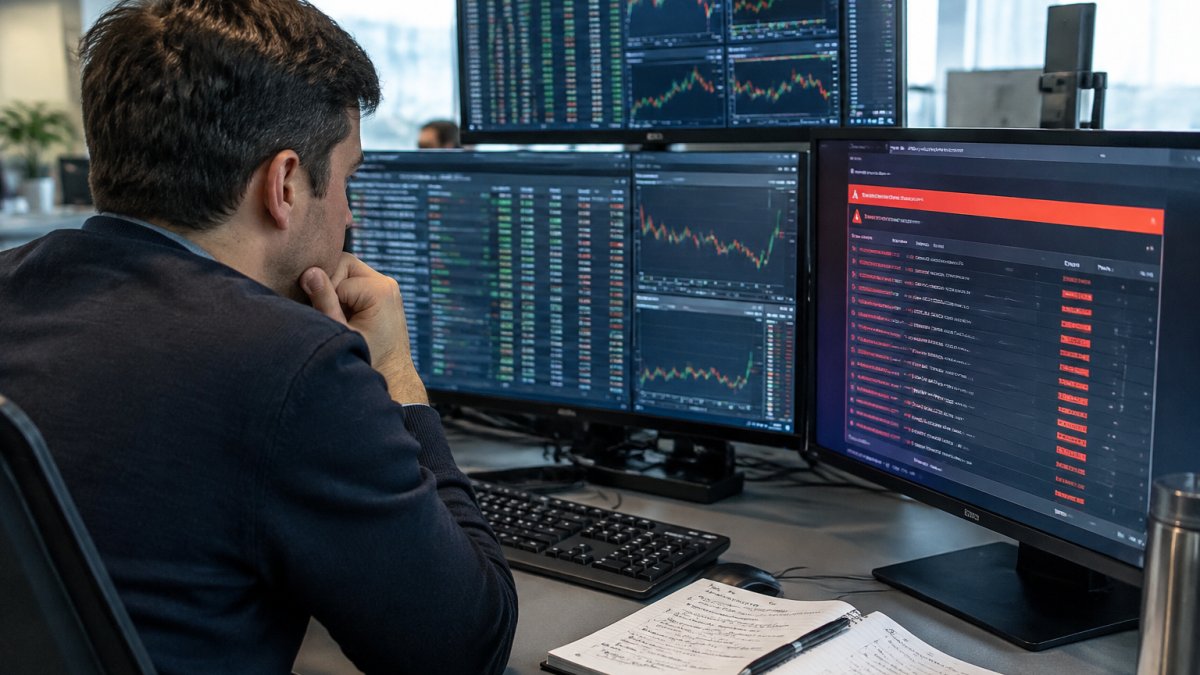
Market data feed monitoring is the practice of watching your price stream for gaps, delays, and dropouts in real time. It turns a silent failure into a visible alert.
A feed can fail without crashing. Quotes freeze, spreads widen oddly, or updates stop for a few seconds. Without monitoring, you trade straight through it.
Build a simple response plan:
- Detect: set alerts for quote gaps and latency spikes
- Pause: stop new orders when the feed is suspect
- Confirm: cross-check against a second source
- Log: record the incident and its effect on fills
Around major events, volatility spikes and feed strain rise together. Our breakdown of news trading risks and prop firm rules covers what to weigh before trading those windows. For traders building a wider safety net, these risk management software picks for day traders are worth reviewing.
A Practical Feed-Quality Audit Checklist
Use this checklist before you trust any feed with real decisions. Run it quarterly, and again after any platform change.
- Compare your quotes against a second independent source
- Time the delay between an exchange update and your screen
- Check for gaps during high-volume periods
- Confirm spreads stay within normal ranges
- Review fills against expected prices for the last month
- Verify your backtesting data matches live feed behavior
- Document each data provider and its update frequency
Backtest accuracy depends on this step. A strategy tested on clean historical data can fail on a live feed with hidden gaps. If your audit keeps flagging execution problems, connect it to your broader prop firm risk management strategy so the fix holds over time.
Choosing a Data Feed Setup That Matches Your Trading Style
The right feed depends on how you trade, not on which option sounds most advanced. Match the setup to your strategy and your risk tolerance.
- Scalpers and fast intraday traders: prioritize low latency and a direct feed
- Swing and multi-asset traders: favor consolidated data for full market depth
- Algorithmic traders: demand clean, order-level data and strict monitoring
Cost matters too. Faster feeds and broader coverage usually carry higher fees, so weigh the trade-off against your order sizes and holding periods. If you are still selecting a platform, our guide on how to choose a reliable futures trading platform walks through the data setup to look for.
Feed quality is not a background detail. It is the foundation under every fill, and weak data will undo strong discipline. At Duncan Funded, we give disciplined traders a transparent path to prove their skill.
Frequently Asked Questions
How does data feed latency affect trade execution?
Latency is the gap between a market event and your platform receiving it. A delay of even a few hundred milliseconds can mean your order reaches the market after the price you saw has already moved. For fast strategies, that gap shows up as worse fill prices and higher execution shortfall. Slower strategies absorb more latency without damage, which is why matching your feed speed to your holding period matters more than chasing the lowest number available.
How can traders tell if a market data feed is stale?
Compare timestamps on incoming quotes against a second source and watch for gaps in the update sequence. A feed that stops updating while the underlying market is active is stale, even if the platform still displays a price. Set alerts for quote age thresholds and for missing sequence numbers. During fast markets, stale market data is most dangerous because the displayed price looks valid while the real market has moved away from it.
What is the difference between a direct and consolidated market data feed?
A direct feed comes straight from a single exchange or venue, so it is faster and shows that venue's full depth, but it only covers that venue. A consolidated feed merges quotes from multiple venues into one stream, giving a fuller picture of the market at the cost of some added latency. Traders working one instrument on one venue often prefer direct; traders who need a complete view across fragmented markets lean on consolidated data.
What data feed metrics matter most for automated trading?
Track four things: latency (median and worst case), quote age, message completeness, and uptime during your trading hours. Worst-case latency matters more than the average because automated strategies fail on outliers, not on typical conditions. Also log rejected or out-of-sequence messages. Run these metrics through backtests and compare simulated fills against live results; a wide gap between the two usually points to feed problems rather than strategy flaws.