 How-to
How to Choose a Reliable Futures Trading Platform
Quick Summary
A reliable futures trading platform executes orders consistently, displays accurate market data, stays online during volatile sessions, and gives clear risk controls. Confirm its regulatory registration, compare the all-in cost per round turn, and test it in a demo account during the sessions you actually trade.
- Check whether the platform appears in the National Futures Association's BASIC registration database.
- Add commission per side, exchange fees, regulatory fees and data charges to find the all-in cost.
- Measure slippage by comparing on-screen prices at click time with your fill prices.
- Ask how working orders stay active on the exchange if your interface goes down.
- Run a demo account on your top two platforms for at least two weeks before funding.
Table of Contents
- What Makes a Futures Trading Platform Reliable
- Comparing Futures Trading Platform Fees
- Checking Execution Speed, Uptime, and Market Data Quality
- Evaluating Futures Trading Platform Features
- Testing a Futures Trading Demo Account Before Funding
- Judging Futures Trading Risk Management Tools
- Verifying Security, Registration, and Your Next Step
- Frequently Asked Questions
How to Choose a Reliable Futures Trading Platform
Last Updated: November 11, 2026
What Makes a Futures Trading Platform Reliable
Choosing a futures trading platform is one of the most consequential decisions a trader makes, because the platform controls order execution, data quality, and risk controls. Traders often decide too quickly, sometimes based on marketing claims rather than verifiable performance. A reliable futures trading platform is one that executes orders consistently, displays accurate market data, stays online during volatile sessions, and gives you clear risk controls. Start with those four criteria before comparing any feature list.
Reliability is measurable. Check whether the platform's regulatory status is listed on the National Futures Association's BASIC system at NFA BASIC registration database. Registration does not guarantee good service, but a platform that cannot show it is a warning sign.
Watch out: a platform that looks polished in a demo can still lag during fast markets. Test it during the session you actually trade.
Comparing Futures Trading Platform Fees
Fees are the most visible cost, but the headline commission is only one line in what you actually pay. A useful comparison adds every charge that applies to a single round turn, meaning one contract opened and then closed, and then multiplies that figure by how often you trade. Traders who skip this step often choose a platform that looks cheap on commissions and expensive once data and monthly fees are counted.
Build the all-in figure from these components:
- Commission per side: the platform's charge each time you open or close a contract. Multiply by two for a round turn.
- Exchange and clearing fees: the per-contract charges passed through from the exchange. These vary by contract and are often shown separately from the platform commission.
- NFA and regulatory fees: small per-contract assessments that appear on most futures statements.
- Market data subscriptions: monthly or per-exchange charges for real-time quotes. These can be waived in some cases but are often billed separately.
- Platform or software fees: monthly charges for advanced tools, or fees that are waived above a certain trading volume.
Here is a simplified illustration using hypothetical numbers for a single E-mini S&P 500 contract. Assume a platform commission of $2.50 per side, an exchange and clearing fee of $1.40 per side, a regulatory fee of $0.02 per side, and a $10.00 monthly real-time data fee. A single round turn costs about $7.84 in per-contract charges before the data fee. If you trade 40 round turns in a month, that is $313.60 in per-contract costs, and the $10.00 data fee brings the total to $323.60, or about $8.09 per round turn. Change any one input, such as moving from 40 to 10 round turns, and the data fee's share of the total rises sharply. Light traders often find that a fixed monthly data charge matters more than the commission rate.
The same arithmetic should be run for each platform you are considering, using the contracts and trade volume you actually expect. Confirm the current figures directly with each provider, because fee schedules change and differ by account type. Ask for a written fee schedule rather than relying on a summary page.
Watch out: a platform that waives its data fee only above a volume threshold can cost more than its competitor for a trader who sits just below that threshold. Model your expected volume before assuming the waiver applies.
The article breaks the all-in cost of a futures platform into these components.
| Cost component | What it covers | Note |
|---|---|---|
| Commission per side | Platform charge each time a contract is opened or closed | Multiply by two for a round turn |
| Exchange and clearing fees | Per-contract charges passed through from the exchange | Vary by contract |
| NFA and regulatory fees | Small per-contract assessments on futures statements | Appear on most statements |
| Market data subscriptions | Monthly or per-exchange real-time quote charges | Can be waived in some cases |
| Platform or software fees | Monthly charges for advanced tools | May be waived above a volume threshold |
Checking Execution Speed, Uptime, and Market Data Quality
Execution quality, uptime, and data accuracy are the three operational questions that determine whether a platform performs when you need it. Marketing pages rarely give you the numbers to judge them, so the useful approach is to know what to ask for and how to test it yourself.
Start with execution. Slippage is the gap between the price you expected and the price you received. To measure it, record the price on your screen at the moment you click, then compare it to the fill price in your statement. Do this across several trades during the same session, including at least one during a busy period such as the open or a scheduled economic release. Ask the provider whether it publishes fill statistics and how it routes orders to exchanges, because routing choices affect fill quality.
Market data accuracy is the second check. Delayed or incorrect quotes lead to poor entries and missed exits. Compare the platform's last-trade price and bid-ask spread against a second independent source during the same minutes. Note any timestamp mismatches. The CME Group publishes market data and connectivity information that can help you understand how exchange feeds are distributed, at CME Group market data resources.
Uptime and outage handling need the most scrutiny, because they are the least visible until something goes wrong. Evaluate a platform on these points:
- Status history: whether the provider publishes an incident log showing past outages, their duration, and their causes.
- Communication: how quickly and through which channels the provider notifies clients during an outage.
- Backup access: whether you can reach the market by a second route, such as a mobile app, a web version, or a phone-based order desk, if the primary platform fails.
- Order cancellation during an outage: whether working orders remain active on the exchange, and whether you can cancel them if your interface is down. Ask the provider to explain this in writing, because the answer determines whether a stop you placed is still protecting you.
- Support during volatility: whether support is staffed during the sessions you trade, and whether it has capacity during major news events.
A common pattern is that outages cluster around high-volatility releases, when message volume spikes. Ask the provider how its infrastructure handles those periods, rather than only asking about average uptime.
Watch out: a platform that reports strong average uptime may still fail during the few minutes that matter most to you. Judge resilience by how the provider behaves during its worst incidents, not by its headline percentage.
Evaluating Futures Trading Platform Features
Feature lists are long, so focus on what you will use daily. Charting tools, order types such as bracket and trailing stops, depth-of-market displays, and one-click trading are the core set for most futures traders. Confirm the platform supports the specific contracts you trade, including micro contracts if you size positions small.
Mobile access and desktop stability both matter. A platform that works well on your desktop but freezes on your phone can leave you unable to manage an open position. Test both before you rely on either.
Our practical advice: list your five most-used features before opening any comparison page. Score each platform against that list instead of against a generic checklist. Some firms use static or trailing drawdown rules, so check which risk model applies before relying on platform alerts.
Testing a Futures Trading Demo Account Before Funding
A demo account is the cheapest way to test a futures trading platform before you risk capital. Use it to practice order entry, stop placement, and position sizing. Trade the same contracts and session hours you plan to use live.
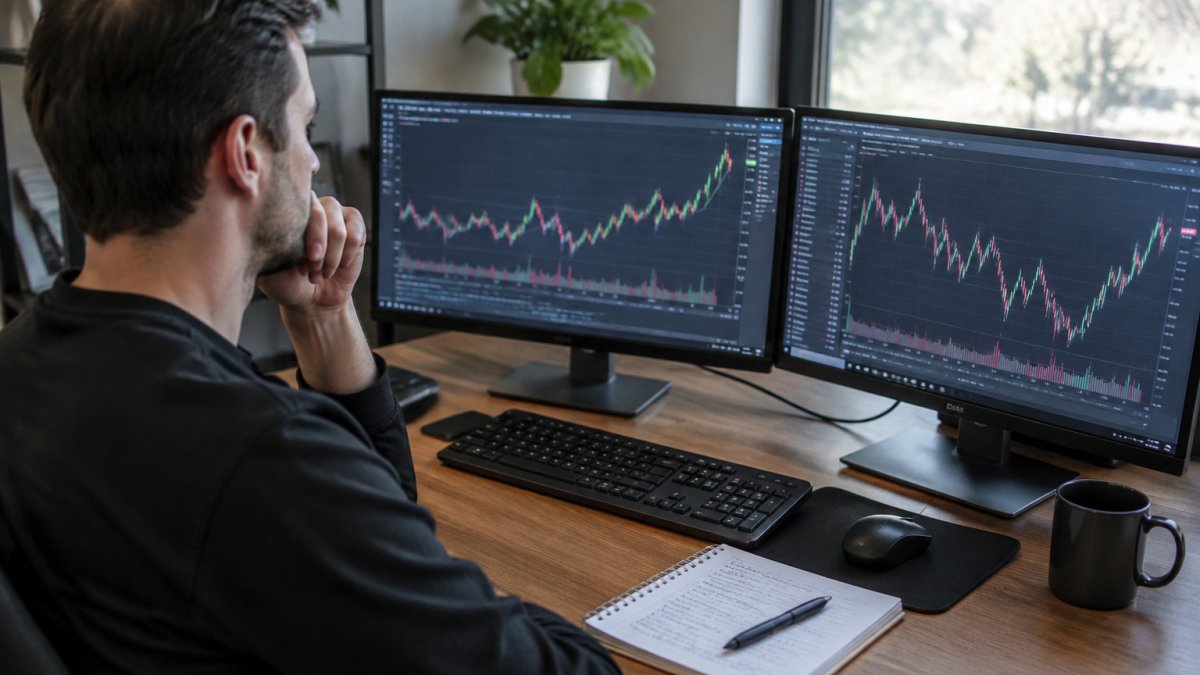
A trader at a desk reviewing charts on two monitors, with a written trade plan beside the keyboard, is the right mindset for demo testing. Record every order, fill, and error during the test period. Simulated fills often differ from live results, so treat demo performance as a check on the interface and workflow, not a forecast of profit.
Judging Futures Trading Risk Management Tools
Risk tools decide whether a bad day stays a bad day. Look for hard stop orders that execute reliably, position limits you can set, and clear margin displays that update in real time. Understand the difference between initial and maintenance margin, and confirm how the platform handles a margin call.
Many traders also look for drawdown and loss-limit alerts. Check whether these alerts are configurable and whether they trigger before a position is closed automatically. If the platform cannot show exactly how it enforces your limits, treat that gap as a risk in itself.
Verifying Security, Registration, and Your Next Step
Before funding any account, verify the firm's registration, its data-security practices, and how it protects client funds. Confirm two-factor authentication is available and that account credentials are not shared across services. Check the Commodity Futures Trading Commission's registration search at CFTC registration and enforcement resources to confirm the entities involved.
Once you have narrowed your list, run a demo on your top two choices for at least two weeks, then compare fees, execution, and risk controls side by side. If you are evaluating a funded program alongside a platform, Duncan Funded offers structured simulated evaluations across futures, forex, crypto, and equities, with transparent rules and certification by The Financial Commission. Before committing, check which Duncan Funded programs allow weekend holding. Visit Duncan Funded's website for current program details and pricing.
Frequently Asked Questions
Which trading platform is best for futures?
No single platform is best for every trader. The right choice depends on your strategy, the contracts you trade, and how much you value execution speed, charting tools, and support. Start by shortlisting two or three platforms, then compare total costs on the trades you actually plan to make. Test each one in a demo account for several sessions during live market hours before committing real capital. Check the platform's order types, data feeds, and margin rates, since these differ widely between providers and change over time.
What makes a futures trading platform reliable?
Reliability comes from consistent uptime, fast and accurate order execution, dependable market data, and transparent pricing. Ask the provider about its uptime record and how it handles outages, including whether you can still manage open positions. Look for clear disclosure of commissions, exchange fees, and margin requirements. Check that the broker or futures commission merchant is registered with the National Futures Association, which you can verify through its BASIC database. Independent reviews and your own testing matter more than marketing claims.
Can I practice futures trading before using real money?
Yes. Most reputable platforms offer a demo or paper trading account that uses live or delayed market data and simulated orders. Use it to learn the order entry process, test your charting setup, and practice managing stop orders and position sizing. Keep in mind that demo fills are often more favorable than real fills, so slippage and execution delays will not show up fully in simulation. Treat the demo as a way to build process and familiarity, not as proof of profitability.
What risk management tools should a futures trading platform offer?
At minimum, a futures platform should let you place stop-loss and stop-limit orders, set bracket orders that attach profit targets and stops to an entry, and view your margin usage and buying power in real time. Useful extras include position size calculators, alerts when margin levels change, and the ability to flatten all positions quickly. Confirm these tools work the way the platform describes by testing them in a demo account before you rely on them with live contracts.