 How-to
7 Strategies for Avoiding Overtrading in Volatile Markets
Last Updated: November 12, 2026
Quick Summary
Avoid overtrading in volatile markets by trading only written, predefined setups and running a pre-trade checklist covering setup validity, risk/reward, portfolio exposure and emotional state. Cap daily trades and losses, and shrink position size as stops widen so risk per trade stays fixed.
- Overtrading means entering more positions than your plan allows because emotion drives the decision.
- Run a pre-market checklist that sets your daily trade limit, max risk per trade and a hard screen-time stop.
- Use position size = risk per trade ÷ stop distance, so a wider stop automatically means a smaller position.
- Lower the daily trade cap and daily loss limit when volatility rises, since each loss is larger.
- Track trade frequency, average risk per trade and drawdown weekly to confirm your rules work.
Table of Contents
- Why Volatile Markets Push Traders Into Overtrading
- How to Stop Overtrading and Revenge Trading
- Build a Trading Plan Checklist Before the Open
- Day Trading Risk Management: Position Size, Stop-Loss, and Trade Caps
- A Volatile Market Example: Two Traders, Two Outcomes
- Measure Whether Your Anti-Overtrading Rules Actually Work
- Submit a Disciplined Evaluation to Duncan Funded
- Frequently Asked Questions
Why Volatile Markets Push Traders Into Overtrading
Volatile markets reward patience and punish restlessness, yet they trigger the opposite behavior in most traders. When price swings widen, the urge to act spikes.
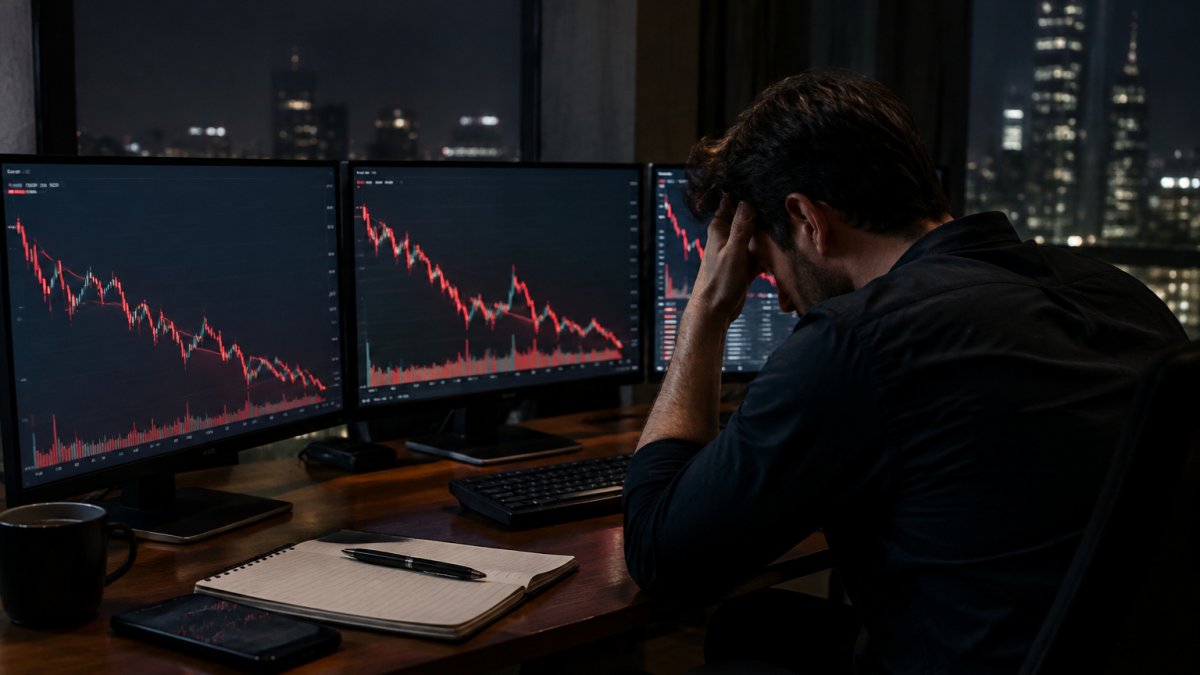
Overtrading is the practice of entering more positions than your plan allows, usually because emotion is driving the decision instead of a predefined setup.
The pattern is predictable. Fast moves create fast feelings.
- A sudden breakout pulls you in before your entry criteria trigger
- A quick loss pushes you to win it back immediately
- A quiet stretch makes you hunt for action that isn't there
Market volatility magnifies all three. Wider ranges mean bigger swings in your account, and bigger swings mean stronger emotions.
The Psychology Behind Impulsive Trading
Fear of missing out and fear of loss pull in opposite directions, and both push you to click. Stress narrows attention, so you see the move but not the risk. Self-awareness is the first defense: name the feeling before you name the trade.
Boredom is often a quiet culprit. A sideways market with no clean setup feels like wasted time, so they force trades to feel productive. That is emotional trading wearing a disguise. Related reading on prop trading psychology covers how funded traders build emotional control and repeatable routines.
How to Stop Overtrading and Revenge Trading
Stopping overtrading starts with one rule: no trade without a written reason. Revenge trading is the subset where you re-enter to recover a loss, and it is the fastest route to a blown account.
A common mistake is sizing up right after a loss. The math works against you. You take on more risk at the exact moment your judgment is worst.
Breaking the Revenge Trading Cycle
The cycle runs on speed. Loss, anger, instant re-entry, bigger loss. Break it with a mandatory cooling-off period.
- Step away for a set time after any loss beyond your plan
- Write down what happened before you place another order
- Return only when a predefined setup appears on your watchlist
A trading journal makes this concrete. Log the trigger, the feeling, and the outcome. Patterns surface fast, and patterns are what you fix.
Build a Trading Plan Checklist Before the Open
A trading plan checklist is a short list you run through before the market opens that sets your rules for the day. It converts intention into a written standard you can be held to. Most guides stop at the pre-market list. The version that actually prevents overtrading in volatile conditions has two parts: a session setup checklist you run once before the open, and a pre-trade decision checklist you run before every single order.
Run this before every session:
- Review market news and overnight price action
- Mark key levels and build a watchlist of 3-5 names
- Set your daily trade limit and max risk per trade
- Define entry criteria and exit strategy for each setup
- Set price alerts instead of staring at screens
- Confirm position size for current volatility
- Note your cash position and open exposure
- Schedule a hard stop for screen time
That list sets the frame. It does not stop you from clicking. The pre-trade checklist is what stands between a valid setup and an impulse.
The Pre-Trade Decision Checklist
Before you place any order, answer four questions in writing, in your journal, a notes app, or a platform note field. If any answer is no, you do not trade.
- Setup validity. Does this trade match a setup written in my plan, with the entry trigger already met? Not "about to meet", met.
- Risk/reward. Is the distance to my stop and my target at least the ratio my plan requires, measured from the current price rather than the price I wish I had?
- Portfolio exposure. After this trade, would total open risk across all positions stay under my cap? A new position that pushes aggregate risk past the limit is a size problem, not an opportunity.
- Emotional state. Am I calm, or am I chasing, bored, or trying to recover a loss? Name the feeling. If the honest answer is anything other than neutral, the checklist fails.
The setup can be perfect and the trade still wrong if you are taking it for the wrong reason.
Adapting the Checklist to Volatility
The checklist should not be static. When volatility rises, tighten it rather than loosen it:
- Raise the minimum risk/reward requirement, because wider swings mean a wider stop and you need more reward to justify the same risk.
- Require the setup to be on your pre-marked watchlist, not discovered mid-session.
- Add a rule that no new position opens in the first few minutes after a scheduled economic release unless the setup is event-specific.
- Lower the daily trade cap and the daily loss limit in the same session, so the checklist and the risk controls move together.
A structured pre-market, in-session, and post-market routine is what separates disciplined traders from reactive ones. Related reading on building a trading routine walks through that full framework.
Day Trading Risk Management: Position Size, Stop-Loss, and Trade Caps
Day trading risk management is the set of rules that caps how much you can lose before emotion takes over. Three controls do most of the work: position size, stop-loss orders, and a daily trade cap.
Start with risk per trade. Many disciplined traders cap it at a small, fixed slice of capital and hold it constant. Then set a stop-loss order at a level the setup invalidates, not at a dollar amount that feels comfortable.
The Volatility-Adjusted Sizing Formula
The relationship is simple: position size = risk per trade ÷ stop distance per share (or contract). Risk stays fixed; size flexes with the market.
Worked example. Suppose your plan allows $200 of risk per trade and you trade a stock at $50.
- Calm conditions: your setup invalidates 1 point away, so the stop distance is $1.00 per share. Position size = $200 ÷ $1.00 = 200 shares. Dollar exposure = 200 × $50 = $10,000.
- Volatile conditions: the same setup now needs a 2-point stop because the average range has widened, so the stop distance is $2.00 per share. Position size = $200 ÷ $2.00 = 100 shares. Dollar exposure = 100 × $50 = $5,000.
Same risk, half the size. That is the whole framework. When volatility rises, the stop widens and the position shrinks automatically, you do not need a new rule, you need the same formula applied to a wider stop. Traders who keep size constant while stops widen are quietly doubling their risk.
Setting the Trade Cap and Loss Limit
The daily trade cap and daily loss limit are the circuit breakers. A common approach is to set the trade cap at the number of valid setups your plan realistically produces in a session, not at a round number that feels ambitious.
When volatility rises, lower both limits. Wider ranges mean each trade carries more risk and each loss is larger, so the session should end sooner, not later.
| Control | What It Does | Adjust When Volatility Rises |
|---|---|---|
| Position size | Caps loss per trade | Reduce size via the formula |
| Stop-loss order | Defines the exit before entry | Widen level, shrink size |
| Daily trade limit | Stops overtrading | Lower the cap |
| Daily loss limit | Preserves capital | Tighten the limit |
Where Stop Orders Fail in Fast Markets
A stop-loss order is not a guarantee (Stop Orders: Factors to Consider During Volatile Markets).
Watch out: sizing based on the stop distance assumes the stop fills near its level. In event-driven volatility, add a buffer to the stop distance or reduce size further to account for slippage, and avoid relying on stop orders as your only protection through scheduled releases.
Related reading: how to calculate position size on a funded account, and how to manage daily loss limits so one bad session doesn't end your evaluation.
A Volatile Market Example: Two Traders, Two Outcomes
Picture a morning gap and a fast reversal. Both traders see the same price action and the same breakout. Only one has rules.
Trader A takes five trades in the first hour, doubles size after two losses, and hits the daily loss limit before lunch. Trader B waits for the predefined setup, takes one trade at reduced size, and stops for the day after a small gain.
Same market. Different process. Trader B is better positioned to preserve capital; Trader A is more exposed to trading costs and commissions.
The difference wasn't skill. It was a trade frequency ceiling and a cooling-off period written down in advance.
Measure Whether Your Anti-Overtrading Rules Actually Work
An anti-overtrading rule only counts if you can measure it. Track three numbers in your journal each week: trade frequency, average risk per trade, and drawdown.
If trade frequency drops but drawdown doesn't improve, your entries are the problem, not your volume. If both improve, the rule is working. Review performance on a fixed schedule, not after every loss.
Watch out: a rule you abandon after one red day isn't a rule. Give each change a set review window before you judge it. Distinguishing overtrading from legitimate high-frequency opportunity matters here, because some volatile sessions genuinely offer more valid setups.
Submit a Disciplined Evaluation to Duncan Funded
Traders who pass evaluations are often those whose risk management holds when markets get loud. Duncan Funded was founded by a U.S. Army Colonel (Ret.) and built on discipline, honor, and legacy, with transparent rules and no hidden conditions.
If your rules are ready, put them to the test. Related reading on how trading evaluations work explains what the process measures.
Volatile markets will always tempt you to trade more than you should. The fix isn't willpower; it's a written plan, a hard trade cap, and risk controls that flex with volatility.
Frequently Asked Questions
What is overtrading, and why does volatility make it worse?
Overtrading means taking more positions than your plan allows, usually because price action feels too good to ignore. Volatile markets worsen it in two ways: wider price swings create more setups that look tradable, and faster losses trigger emotional trading to win the money back. The result is higher commissions, larger drawdown, and decisions made on impulse rather than a predefined setup. A daily trade limit and a written trading plan are the fastest defenses.
How do I know when to stop trading for the day?
Set the stopping point before the session starts, not after a loss. Common rules include a daily loss cap (for example, 1-2% of account equity), a maximum number of trades, and a hard stop after two consecutive losses. Once any limit is hit, close the platform and step away for a cooling-off period. Traders who decide in advance avoid the in-the-moment bargaining that turns one bad trade into five.
How can I tell whether a volatile market offers a valid trading setup?
A valid setup matches your written entry criteria exactly: the same pattern, the same timeframe, the same confirmation. If you have to talk yourself into the trade, it is not your setup. In volatile conditions, add a filter such as requiring price to clear a consolidation range or wait for the first 15 minutes of the session to pass. If the setup does not appear on your watchlist with a price alert already set, skip it.
What risk-management rules help limit losses in volatile markets?
Reduce position size as volatility rises so your dollar risk per trade stays constant. Keep a fixed risk per trade, typically 0.5-1% of account equity, and place a stop-loss order at entry rather than adjusting it later. Cap daily trades and daily losses, and track a risk/reward ratio of at least 2:1 on every position. These rules protect capital preservation first, which is what keeps a trading account alive long enough to compound.