 How-to
How to Start a Trading Career From Home: 2026 Guide
Table of Contents
- How to Start a Trading Career From Home: A Staged Roadmap
- How to Start Day Trading for Beginners Without Blowing Up
- Build a Trading From Home Setup That Won't Distract You
- Use a Trading Plan Template to Define Your Rules
- Paper Trading for Beginners: Practice Before You Pay
- What a Trading Career From Home Actually Costs
- Legal, Tax, and Regulatory Basics for Self-Employed Traders
- How to Evaluate Remote Funded-Trader Offers
- Frequently Asked Questions
Last Updated: October 20, 2026
How to Start a Trading Career From Home: A Staged Roadmap
Building a trading career from home takes more than a laptop and a broker login. It takes a staged plan, a fixed budget, and the patience to prove yourself before you scale. At Duncan Funded, we evaluate traders every day, and the ones who last follow a clear path.
Below, we break that path into three stages. Each stage has a finish line you can measure, not a vague feeling that you're "ready."
| Stage | Focus | Typical Duration | Milestone to Pass |
|---|---|---|---|
| 1. Learn | Market basics, rules | 2-3 months | Can explain your strategy in writing |
| 2. Practice | Simulator, then small live account | 3-6 months | 100+ logged practice trades |
| 3. Prove | Consistency, risk control | 3-6 months | Steady results across 3 months |
Stage 1: Learn the Market Before You Fund Anything
Start with education, not deposits. A trading career is built on understanding financial markets, order types, and how prices move.
Focus your first weeks on:
- Market structure and trading hours
- Order types: market, limit, stop
- Risk management basics
- One market only, such as equities or futures
A common mistake is studying five markets at once. Pick one. Learn it cold before you add another.
Stage 2: Practice With a Simulator, Then a Small Live Account
Paper trading comes first. A demo account lets you practice trades with zero capital at risk.
Set a rule: log at least 100 practice trades before you go live. Track entry, exit, and why you took the trade.
Then fund a small live account. The goal is not profit. It is to feel real emotions with real money on the line.
Stage 3: Prove Consistency Before You Scale
Consistency beats a lucky month. Before you add capital, show steady results over at least three months.
Measure yourself on:
- Win rate and average win versus average loss
- Maximum drawdown
- How often you follow your own rules
This is exactly what a structured evaluation tests. Duncan Funded runs simulated evaluations across Forex, Futures, Crypto, and Equities, and the pass criteria are published up front, with no hidden conditions.
How to Start Day Trading for Beginners Without Blowing Up
Day trading is buying and selling within the same session to profit from short-term price moves. It is fast, and it punishes poor risk control.
Here is how beginners avoid the common blow-up:
- Risk a small, fixed amount per trade
- Set a daily loss limit and stop when you hit it
- Trade one setup until it is second nature
- Keep a written journal of every trade
The thing nobody tells you about day trading is that most losses come from breaking your own rules, not from bad analysis.
Build a Trading From Home Setup That Won't Distract You
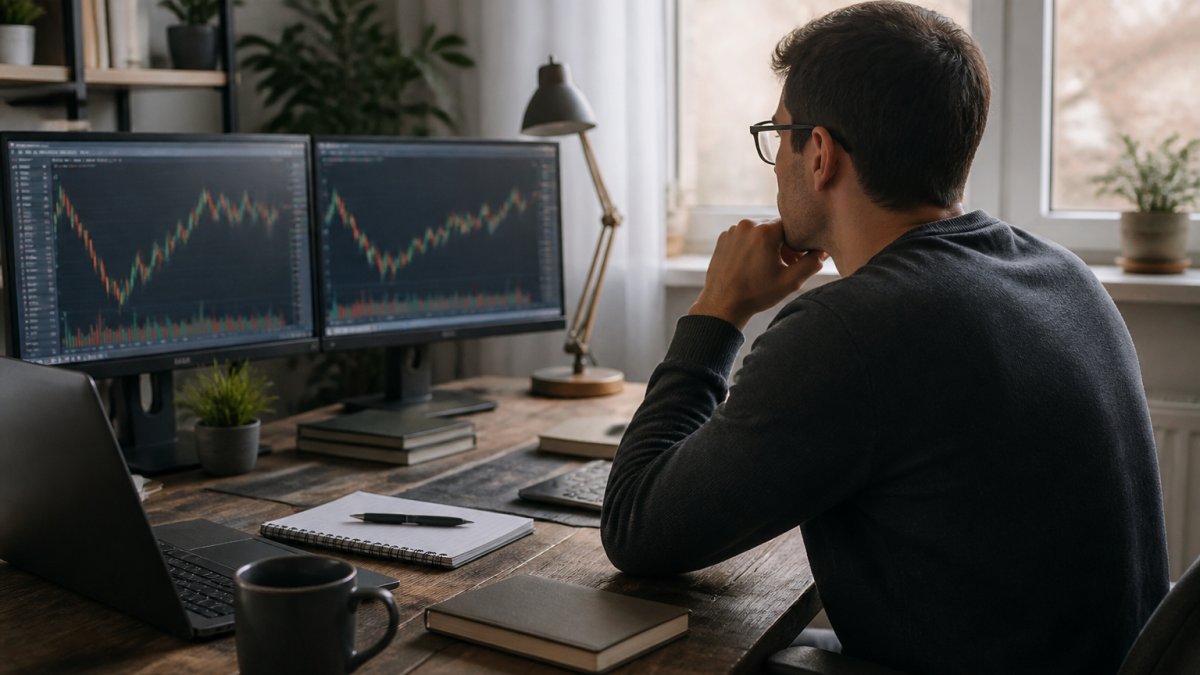
A simple, quiet setup beats an expensive one. You need a reliable computer, a stable internet connection, and a space you can close off from the rest of the house.

Keep it basic:
- One good laptop or desktop
- A second monitor for charts and news
- Wired internet where possible
- A door you can shut
Multiple monitors help, but they are not required to start. What matters is that your trading desk is a place you associate with focus, not laundry and notifications.
Use a Trading Plan Template to Define Your Rules
A trading plan is a written document that states what you trade, when you trade, and how much you risk. Without one, you are guessing.
Fill in this template before your next session:
My Trading Plan
- Markets I trade: __________
- Sessions/hours: __________
- Setup I look for: __________
- Risk per trade: ____% of account
- Daily loss limit: ____%
- Max trades per day: ____
- Rules for stopping: __________
- Review day: __________
Review it weekly. If you broke a rule, write down why. A trading plan template only works if you actually follow it.
Paper Trading for Beginners: Practice Before You Pay
Paper trading is simulated trading with fake money and real market data. It lets you test a strategy without risking capital.
Use it to practice three things:
- Executing trades cleanly
- Sitting through drawdown without panic
- Following your plan under pressure
Paper trading for beginners has one limit: it removes fear. That is why you graduate to a small live account once your process is solid.
What a Trading Career From Home Actually Costs
Most guides wave at costs. This section breaks them into essentials and optional purchases so you can build a startup budget before you fund an account. Confirm current pricing with each provider, because commissions and data fees change.
Essential startup costs
| Item | Typical U.S. range | Notes |
|---|---|---|
| Trading capital | $500-$5,000 to start | Enough to trade one share or one micro contract with risk rules intact; not a target for profit |
| Brokerage commissions | $0-$2.50 per options contract; $0-$5 per stock trade; $0.50-$2.50 per micro futures contract | Many equity brokers are commission-free but earn on order flow; futures brokers charge per contract |
| Market data | $0-$50/month | Delayed data is often free; real-time Level 2 and futures data usually carry exchange fees |
| Charting platform | $0-$60/month | Free tiers exist; paid tiers add indicators, backtesting, and multiple charts |
| Computer | $400-$1,200 one-time | A mid-range laptop or desktop is sufficient; you do not need a trading-specific machine |
| Internet | $50-$90/month | Wired connection preferred; a backup hotspot is cheap insurance |
Optional but common purchases
- Second monitor: Helpful for charts plus order entry, not required to start.
- Education: Free broker education and public regulatory resources cover the basics; paid courses are optional and quality varies widely.
- Tax or accounting software: Worth it once you have reportable trading activity.
- Backtesting or journaling tools: A spreadsheet works at the start.
A realistic first-year budget
A bare-bones setup, one market, free charting, delayed data, a mid-range computer, and trading capital, requires a budget that separates capital from operating costs. Neither figure includes losses, which are a normal part of the learning curve and should be budgeted separately from operating costs.
A realistic income timeline also matters: most beginners should expect months of flat or negative results before consistency appears, so do not count on trading income to cover these costs in year one.
Legal, Tax, and Regulatory Basics for Self-Employed Traders
Self-employed traders in the United States face real obligations. Trading income is generally taxable, and frequent trading can trigger specific reporting rules.
Keep these in mind:
- Track every trade for tax reporting
- Understand short-term versus long-term treatment
- Register as self-employed if you trade as a business
- Check the IRS guidance on trader tax status for current rules
Rules change, so confirm details with a qualified tax professional and the official source. This is general information, not tax advice.
How to Evaluate Remote Funded-Trader Offers
Funded trading offers let you trade a firm's capital after passing an evaluation. Some are legitimate businesses; others are designed to collect evaluation fees from traders who never reach a payout. The difference usually shows up in the fine print of five terms.
The five terms that decide whether an offer is worth the fee
- Evaluation fee and refund policy. Ask whether the fee is refunded on your first payout or on passing, and whether there is a separate activation fee.
- Drawdown rules. Distinguish between a trailing maximum drawdown (which moves up with your profits and can stop you out on a normal pullback) and a static drawdown (fixed from your starting balance). Also check the daily loss limit and whether open positions count toward it.
- Profit target and time limits. A 10% target with no time limit is a very different proposition from an 8% target in 30 days. Minimum trading days matter too, they can force you to trade when no setup exists.
- Payout conditions and profit split. Typical splits range from 70/30 to 90/10 in the trader's favor. Confirm the minimum payout amount, the payout cadence, and whether profits from the evaluation phase carry over or reset.
- Restrictions. Check prohibited strategies (news trading, holding overnight, high-frequency scalping), instrument availability, and whether you trade a simulated account or live capital. Most evaluations are simulated; that is normal, but it should be disclosed.
Questions to ask before you pay
- Are the full rules published before checkout, or only after?
- Is the firm a member of a recognized dispute-resolution body?
- What happens if you narrowly miss a target, is there a retry, and at what cost?
- Can you withdraw profits on a schedule you can plan around?
- Are there backend fees taken from payouts?
Duncan Funded is certified by The Financial Commission under its Prop Firm Certification framework, and our rules are published in full with no hidden conditions. We were founded by Tommy Duncan, a U.S. Army Colonel (Ret.), on the principles of discipline and honor. Traders who pass gain access to notionally funded accounts and can manage six-figure simulated capital.
For broader context on how firms and trading are regulated, see the CFTC customer education resources.
Frequently Asked Questions
Is it true that 97% of day traders lose money?
That figure circulates widely, but treat any single percentage with caution. What the research consistently shows is that most retail day traders underperform over time, and a small minority account for most profits. The practical takeaway is not a precise number but a mindset: assume you will lose money while learning, cap your risk per trade, and treat your first year as paid education. Paper trading and a written trading plan reduce the cost of that learning curve before real capital is on the line.
How much money do you need to start a trading career from home?
There is no official minimum, and any figure depends on your market and strategy. Budget for three things: education and data, equipment such as a reliable computer and internet connection, and risk capital you can afford to lose entirely. Many beginners start with a simulator at no cost, then fund a small live account. If you pursue a funded evaluation, the fee is a separate cost from your trading capital. Check current pricing directly with any firm before committing.
Can you make a living trading from home?
Some traders do, but it usually takes years of consistent results before withdrawals cover living expenses. A realistic timeline involves months of paper trading, then a small live account, then gradual scaling only after you have a documented track record. Plan for drawdowns and months with no profit. Keep separate savings so you are not forced to trade for income before your strategy is proven, and review your performance monthly against your written trading plan.
What equipment do you need to trade from home?
A dependable computer, a stable high-speed internet connection, and a backup connection such as a mobile hotspot cover the basics. One or two monitors help if you track multiple charts, but they are not required to start. You also need a brokerage or platform account, charting software, and a quiet space where you will not be interrupted. Test your full trading from home setup during market hours before you rely on it with real capital.