 blog
7 Daily Habits of a Full-Time Professional Trader
Last Updated: November 4, 2026
Quick Summary
The 7 daily habits of a full time professional trader are a pre-market checklist, set trading hours with strict setup criteria, enforced risk management, a written trading plan, a daily trading journal, measurable performance review, and a routine for losing days. Together they make trading a repeatable process rather than a reaction to the market.
- Complete a short written pre-market checklist before placing any trade.
- Trade only during set hours and only when a setup meets written criteria.
- Risk a small fixed percentage per trade and stop trading at your daily loss limit.
- Log every trade in a journal and review performance weekly using expectancy and rule adherence.
- After reaching your daily loss limit, stop trading and do not try to win back losses.
Table of Contents
- A Realistic Trading Day: Sample Schedule for U.S. Markets
- Habit 1: Build a Pre-Market Trading Checklist Before the Open
- Habit 2: Set Trading Hours and Wait for High-Quality Setups
- Habit 3: Enforce Trading Risk Management Rules on Every Trade
- Habit 4: Follow a Written Trading Plan and Manage Exits
- Habit 5: Keep a Day Trading Journal With Real Examples
- Habit 6: Review Performance With Measurable KPIs and How to Review Day Trading Performance
- Habit 7: Use a Routine for Losing Days and Drawdowns
- Frequently Asked Questions
A Realistic Trading Day: Sample Schedule for U.S. Markets
Most people who want to trade for a living picture the work wrong. They imagine screens full of flashing charts and fast decisions, but the professional's day is mostly preparation, waiting, and review. The 7 daily habits of a full time professional trader are built around that rhythm, and a typical day shows how they fit together. SEC investor guidance on day trading risks
A realistic schedule for U.S. equity and futures markets often looks like this:
- 6:30 to 7:30 a.m. ET: Review overnight news, economic calendar releases, and futures moves.
- 7:30 to 8:30 a.m. ET: Complete the pre-market checklist and mark key levels on the daily chart.
- 9:30 a.m. ET: Regular U.S. stock market open. Trade only the setups that match your plan.
- 9:30 to 11:30 a.m. ET: Most active trading window for many traders. Stop taking new trades once your daily limit is hit.
- Midday: Take a break. Step away from the screen to avoid overtrading.
- 3:00 to 4:00 p.m. ET: Manage open positions into the close and cut any trade that breaks your rules.
- After 4:00 p.m. ET: Log trades, record performance metrics, and note what to improve.
This schedule is an example, not a rule. Your hours depend on your strategy, your time zone, and whether you trade stocks, futures, or forex, since those markets run on different hours.
Habit 1: Build a Pre-Market Trading Checklist Before the Open
A pre-market trading checklist is a short written list you complete before the first trade. It turns preparation into a repeatable process instead of a mood.
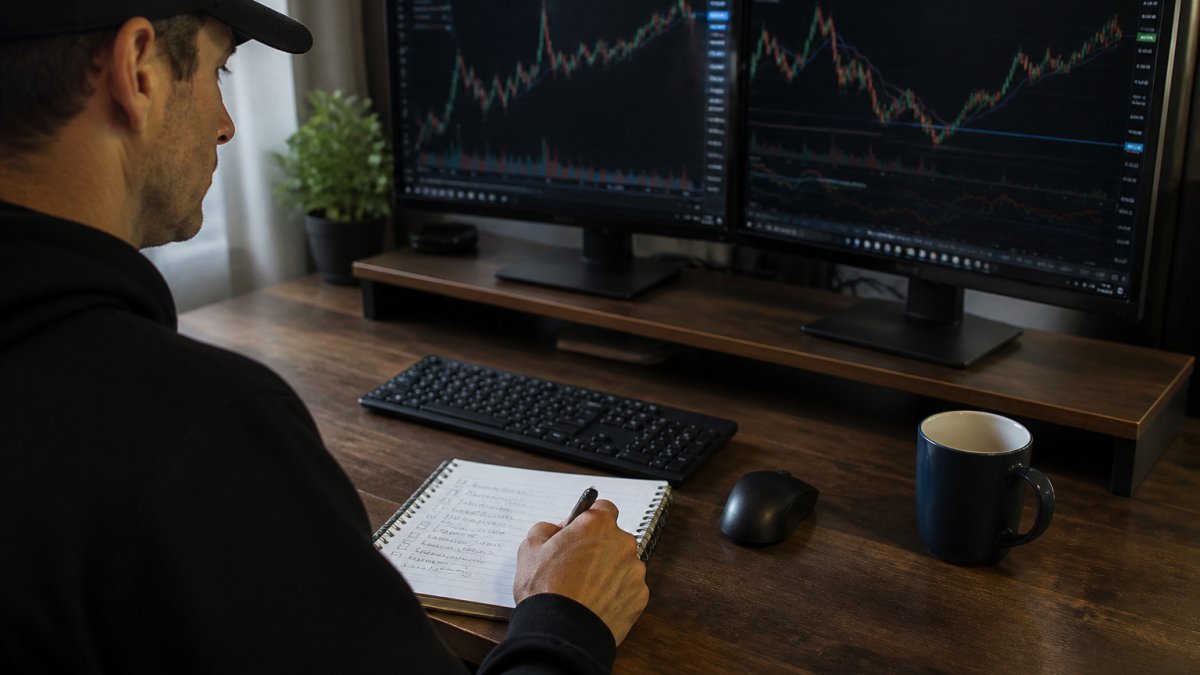
A common mistake is skipping this step on busy or exciting days. Those are the days when a checklist matters most. Keep your list short so you will actually use it:
- Check economic news and earnings due today.
- Note the overall market trend on the daily chart.
- Mark your key support and resistance levels.
- Confirm your maximum loss for the day.
- Write down the setups you will trade and the ones you will ignore.
Print the checklist or keep it in a document you open every morning. Tick each item before you place an order.
Habit 2: Set Trading Hours and Wait for High-Quality Setups
Professional traders do not trade all day. They set specific trading hours and wait for setups that meet written criteria. The habit has two parts: choosing hours that match your market and your life, and defining a valid setup precisely enough that you can say yes or no without debating yourself.
Trading hours depend on style and instrument, not on willpower. A day trader in equities works the regular session, 9:30 a.m. to 4:00 p.m. ET, with the first 90 minutes and the closing hour carrying most of the volume.
Define a valid setup in checklist form. A breakout setup, for example, might require price to close above a marked level, volume at 1.5 times the 20-bar average or better, and a stop no wider than your per-trade risk allows. A pullback setup might require a retest of a prior support level with a rejection candle.
Set a daily trade cap and a session cap. Limiting yourself to a small number of quality trades helps keep overtrading in check, and a hard stop on new entries after a set time can protect you from forcing action during quiet periods.
Watch out: the most common failure is widening your definition of a setup after a slow morning, which turns patience into rationalization. If you catch yourself adding criteria after the fact, close the platform for the day.
Waiting is the skill. Quiet periods are not a signal that the screen should be doing something. If nothing matches your checklist, the correct action is no action, and a session with zero trades that followed the rules is a successful session.
Habit 3: Enforce Trading Risk Management Rules on Every Trade
Risk management decides whether a trader lasts. Capital preservation comes before profit, and position sizing is the main tool for it.
Before entering, decide how much of your account you will risk on that trade. Many traders risk a small fixed percentage per trade and set a daily loss limit that ends trading for the day when reached. Know the difference between daily drawdown and maximum drawdown, since both shape how much room you have to operate. Our guide on daily drawdown vs maximum drawdown explains how these limits work for prop traders. For a practical walkthrough of stopping losses for the day, see our guide on how to manage daily loss limits.
Set a risk-reward ratio for each trade before you enter. A setup risking $100 to make $200 gives you room to be wrong more often and still come out ahead. Always place your stop-loss order at entry so a single bad trade cannot wipe out your week.
Habit 4: Follow a Written Trading Plan and Manage Exits
A trading plan states your strategy, entry rules, exit rules, and position sizing in writing. Without one, decisions drift with emotion.
Exits matter as much as entries. Define your profit target and your stop-loss before you trade. Once in a position, follow those levels. Moving a stop further away to avoid a loss is one of the fastest ways to blow up an account.
Review your plan monthly. Change it only when your data shows a real problem, not because of a single bad week.
Habit 5: Keep a Day Trading Journal With Real Examples
A trade journal is the record that turns experience into improvement. Log every trade with the entry, exit, size, reason for the trade, and how you felt.
Real examples make the journal useful. For instance, a trader might note: "Entered breakout on 1.5 times average volume, stop at prior low, exited at target for a 2R gain, but moved early on a second trade and gave back profit." Entries like this show patterns you cannot see from memory alone.
Review the journal weekly. Look for repeated mistakes, such as trading after a loss or chasing late moves. Our article on what builds confidence in a trader covers how consistent journaling supports disciplined decisions over time.
Habit 6: Review Performance With Measurable KPIs and How to Review Day Trading Performance
Improvement requires measurement, and measurement requires definitions you can compute from your journal without guesswork. Track a short list of key performance indicators, or KPIs, each week, and define each one the same way every time.
Useful KPIs include:
| KPI | Definition | What It Shows |
|---|---|---|
| Win rate | Profitable trades divided by total trades | How often you are right, not how much you make |
| Average win and average loss | Mean profit of winners and mean loss of losers | Whether your edge survives a low win rate |
| Expectancy | (Win rate x average win) minus (loss rate x average loss) | Expected dollars per trade at your current process |
| Average risk-reward | Average win divided by average loss | Whether winners are large enough to pay for losers |
| Rule adherence | Trades that followed every checklist item divided by total trades | Whether results come from your process or from improvisation |
| Trades per day | Count of entries per session | Whether you are overtrading or under-trading |
| Maximum daily loss | Largest single-day loss in the period | Whether your stop rules are actually enforced |
Expectancy is the number that ties the rest together. If you win 40 percent of trades with an average win of $300 and an average loss of $150, expectancy is (0.40 x $300) minus (0.60 x $150), or $30 per trade.
When you review day trading performance, look at rule adherence first. Score each trade as compliant or non-compliant against your written checklist, then compare expectancy for the two groups. A common pattern is that compliant trades carry positive expectancy while non-compliant trades drag the total negative, which tells you the problem is execution, not strategy. If the reverse is true, the plan itself needs revision.
Use backtesting to test changes before you apply them live. Take your last 50 to 100 trades, or a historical sample from your charting platform, and apply the proposed rule change to that data. If the change improves expectancy and adherence across the sample, adopt it on a small position size for a trial period. If it only improves the last few trades, it is probably noise.
Watch out: changing your plan after every losing week is the fastest way to destroy a working edge. Require a minimum sample, such as 30 trades or four weeks, before you judge a change, and write down the reason for the change so you can review it later.
Adjust habits based on evidence, not on the last trade. For more on preparing for evaluations, see our guide on how to avoid drawdown in trading challenges.
Habit 7: Use a Routine for Losing Days and Drawdowns
Every trader has losing days. Professionals plan for them.
When you hit your daily loss limit, stop trading. Close the platform, take a walk, and return to your journal. Do not try to win back losses in the afternoon, since that is how small losses become large ones.
If losses continue across several days, reduce your position size or pause to review your plan. Treat a drawdown as information about your process, not a verdict on your talent. A structured routine for these moments protects your capital and your confidence.
Building this kind of routine takes time. Through structured, simulated evaluations across Forex, Futures, Crypto, and Equities, traders can demonstrate consistency and disciplined decision-making. Duncan Funded was founded by a U.S. Army Colonel (Ret.), and it states that its rules are transparent. Visit Duncan Funded to see how the evaluation works and start building your professional routine.
Frequently Asked Questions
What is a good daily routine for a day trader?
A solid day trader routine starts before the opening bell and ends after the close. Most full-time traders review overnight news and key levels in the pre-market, define their trade setups and daily loss limit, trade only during their chosen session, and then spend time after the close logging trades and reviewing what worked. The exact hours depend on the market you trade and your time zone, so build the schedule around your own sessions rather than copying someone else's. Consistency matters more than length: the same steps, in the same order, every day.
What is the 3-5-7 rule in day trading?
The 3-5-7 rule is a commonly cited guideline for limiting exposure to risk across trades and sessions. Traders adapt its guidance to their own capital and tolerance. Treat it as a starting framework, test it against your own history, and confirm any figures against your broker's and your strategy's requirements before relying on them.
How do professional traders prepare before the market opens?
Professionals typically spend the first part of their day on preparation rather than execution. They scan the economic calendar for scheduled releases, check overnight price action and futures, mark key support and resistance levels on the daily chart, and write down the specific setups they will look for. They also decide in advance how much they will risk and when they will stop. A short written checklist keeps this process repeatable, so preparation does not depend on mood or memory.
How do day traders review and improve their performance?
Reviewing performance means comparing what you planned with what you actually did. After each session, log every trade with entry, exit, size, the setup it fit, and whether you followed your rules. Then calculate measurable indicators such as win rate, average risk-reward ratio, and the number of trades that broke your plan. Look for patterns across weeks, not single days, and change one variable at a time so you can tell whether an adjustment helped.