 Comparison
Are Prop Firm Payouts Reliable and Fast?
Last Updated: October 25, 2026
Quick Summary
Prop firm payouts are reliable when a firm honors valid withdrawal requests within its stated windows, and speed should be judged on firm-controlled stages only. Split total withdrawal time into request-to-approval and approval-to-payment-initiation, since bank and payment rails sit outside the firm's control. Verify payout terms, certification and complaint patterns before paying any challenge fee.
- Payout eligibility depends on minimum trading days, first-withdrawal timing, profit split, payout limits and consistency rules.
- Compare firms only on request-to-approval and approval-to-payment-initiation intervals, not a single speed number.
- Verifiable payout proof must be dated, account-linked, sample-sized and time-bounded.
- Track each withdrawal as on time, delayed, partially paid or rejected across multiple payout cycles.
- Score firms on processing time, rule clarity, dispute process and complaint patterns before enrolling.
Table of Contents
- Why Payout Reliability Matters More Than Profit Split
- Prop Firm Payout Rules: What Actually Governs Your Withdrawal
- Prop Firm Withdrawal Time: Firm Processing vs. External Delays
- How to Verify Prop Firm Payouts Before You Pay a Challenge Fee
- Prop Firm Payout Proof: What Counts as Evidence and What Doesn't
- Payout Denials and Disputes: How to Appeal and What to Expect
- Building a Payout Reliability Scorecard for Your Shortlist
- Evaluating Duncan Funded's Payout Terms Before You Enroll
- Frequently Asked Questions
Why Payout Reliability Matters More Than Profit Split
A 90% profit split means nothing if the money never arrives.
Prop firm payout reliability is the measurable likelihood that a firm honors a valid withdrawal request on the schedule its own rules promise.
Most traders rank profit split first when comparing evaluations. We think that is backwards: a generous split on a firm that delays or denies withdrawals costs you more than a modest split on one that pays on time.
Prop Firm Payout Rules: What Actually Governs Your Withdrawal
Payout eligibility comes down to four levers: minimum trading days, a first-withdrawal waiting period, the profit split, and any consistency or payout-limit rules. Each one is written into the firm's terms, and each one can delay a withdrawal that looks valid on your dashboard.
- Minimum trading days. Most firms require a set number of active days before a payout request is accepted. Days with no trades usually do not count.
- First-withdrawal timing. The first payout often has a longer waiting period than later ones.
- Profit split. The percentage you keep after the split is applied, which may differ between the evaluation and the funded stage.
Read the exact wording for each. A common mistake is assuming "minimum trading days" means calendar days. It almost never does.
Prop Firm Withdrawal Time: Firm Processing vs. External Delays
Prop firm withdrawal time is the total elapsed time from an approved payout request to funds landing in your account.
Stage one is firm processing. Your request goes through verification and a compliance review, then the firm approves it and initiates payment.
Stage two is external. Once payment is initiated, the payment method takes over. Bank transfers, card rails, and digital payment providers each clear on their own timelines, and weekends and holidays stretch them further.
Define the clock before you compare
The biggest mistake traders make is comparing firms on a single "payout speed" number that each firm defines differently. To compare on equivalent terms, break the total into three measurable intervals and ask every firm to quote each separately:
- Request to approval. Time from the moment you submit a compliant withdrawal request to the moment the firm approves it. This includes verification and compliance review.
- Approval to payment initiation. Time from approval to the firm actually sending funds to the payment provider.
- Payment initiation to funds received. Time for the payment method, intermediary banks, and currency conversion to complete.
Only intervals one and two are within the firm's control; interval three depends on your bank, location, and payment rail. A firm that says "payouts in 24 to 48 hours" without specifying which interval is telling you very little, and may be quoting only the fastest interval while total time to funds is far longer.
What each stage actually involves
| Interval | Who controls it | What can delay it |
|---|---|---|
| Request to approval | Firm | Incomplete verification, compliance review, consistency-rule flags, weekends and holidays if staffed thinly |
| Approval to payment initiation | Firm and payment provider | Batch payment schedules, provider cut-off times, missing payment details |
| Payment initiation to funds received | Payment provider, banks, currency conversion | Bank processing windows, intermediary banks, currency conversion, weekends and holidays |
Payment-method and location effects
The same firm can produce very different total times depending on how you withdraw and where you are. Bank transfers typically involve at least one intermediary and can add several business days; card and digital rails are often faster but can carry their own review. Currency conversion adds another step, and traders outside the firm's home currency often see longer settlement.
Separate firm delays from external delays
When a payout is late, attribute the delay before judging the firm. Ask: was the request still in review (firm), had payment been initiated but not settled (provider or bank), or was it rejected (firm)? A firm that initiates payment promptly but whose bank rail is slow is a different reliability profile from one that sits on requests for days. Our guide to understanding simulated trading account payouts explains how payouts on simulated funded accounts are structured end to end.
How to Verify Prop Firm Payouts Before You Pay a Challenge Fee
Verification starts with the firm's own terms, not its testimonials. Pull the payout section of the terms of service and check it against the marketing page.
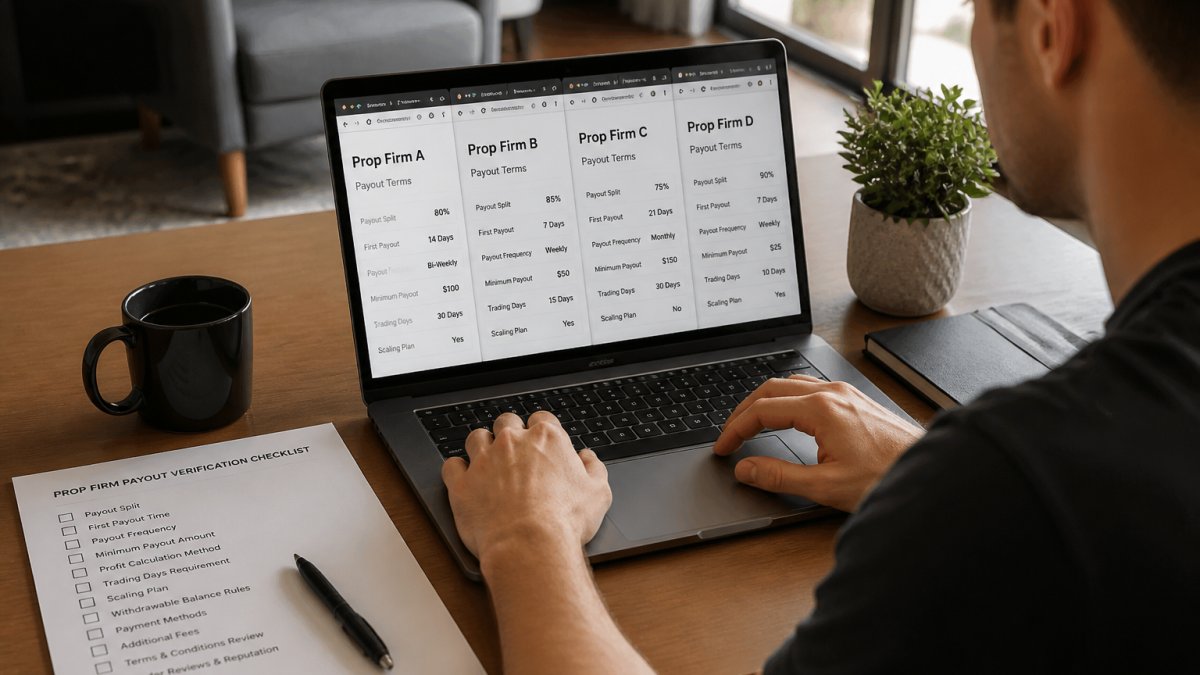
Run this check before you pay anything:
- Confirm the minimum trading days and whether they are active-trading days
- Confirm the first-withdrawal waiting period and later payout frequency
- Confirm the profit split at both evaluation and funded stages
That last item matters. A checklist before buying a prop firm challenge turns these points into a scored pre-purchase review.
Prop Firm Payout Proof: What Counts as Evidence and What Doesn't
Payout proof is any verifiable record that a firm paid a trader on a stated date, and most of what circulates online does not meet that bar. A payment-notification screenshot proves little on its own: it can be edited, come from a different firm, and carry no date or account context.
A verifiable evidence standard
Strong evidence meets four tests. If a claim fails any one of them, downgrade it:
- Dated. The record shows both the request date and the settlement date, not just a payment notification.
- Account-linked. The record ties to a specific account and firm, not an anonymous screenshot.
- Sample-sized. The claim reports how many withdrawals were tested, not a single anecdote. One fast payment is not a track record.
Weaker evidence includes cropped screenshots, influencer videos with no dates, and "proof" threads where the original poster never returns. Treat enthusiasm as a signal to check harder, not as confirmation.
Reliability over time, not one fast payment
The most useful question is not "did this firm pay once?" but "how does this firm behave across multiple payout cycles?" Track four outcomes:
- Successful on time. Paid within the firm's stated window.
- Successful but delayed. Paid, but outside the stated window.
- Partially paid. Paid less than requested, with a stated reason.
A firm with one fast payment and three delayed ones is a different reliability profile from one with four on-time payments. Isolated testimonials cannot distinguish the two; a small tracked sample can.
What to record when you test a firm
If you are evaluating a shortlist, keep a simple log for each withdrawal you make or observe:
| Field | Why it matters |
|---|---|
| Request date and time | Starts the clock |
| Approval date and time | Measures firm review time |
| Payment initiation date and time | Measures firm payment speed |
| Funds received date and time | Measures total time to funds |
| Amount requested and received | Catches partial payments |
| Payment method and currency | Explains external delays |
| Stated reason if delayed or rejected | Distinguishes firm from external cause |
Third-party and certification evidence
Two external sources carry more weight than trader posts: third-party complaint data showing how often payout disputes occur and how they resolved, and public statements from the firm's certification body. Duncan Funded is certified by The Financial Commission under its Prop Firm Certification framework, which gives traders an external body to escalate to, and that certification status is itself a verifiable data point. Not every firm can say the same.
Payout Denials and Disputes: How to Appeal and What to Expect
A payout denial is not always final, but the outcome depends almost entirely on what you can document. Firms typically cite a rule breach, verification issue, or consistency-rule flag; your job is to show, with records, that the rule was not broken.
Appeal in this order:
- Request the specific reason in writing. Ask which rule was cited and which trades triggered it.
- Pull your account statements and trade history covering the period in question.
- Respond in writing within the firm's stated window, referencing the exact rule and your evidence.
- Escalate to the certification body if the firm's own process stalls or produces no reasoned answer.
Keep a dated record of every account from day one. Our article on the account issue that changed how I manage every firm's relationship makes the case for documented account activity, and disputes are exactly where that habit pays off.
Building a Payout Reliability Scorecard for Your Shortlist
Score each firm on payout mechanics, not marketing. Weight reliability above headline profit split, and mark anything you cannot verify as unknown rather than guessing.
| Criterion | What to Check | Weight | Score (1-5) |
|---|---|---|---|
| Processing time | Firm-stage hours quoted in writing | High | |
| Rule clarity | Terms match the marketing page | High | |
| Payout frequency | Requests allowed per period | Medium | |
| Dispute process | Written appeal path and escalation body | High | |
| Certification | Named certifying body and status | Medium | |
| Complaint pattern | Unresolved payout disputes in reviews | High |
Add the weighted scores and keep the raw notes. For side-by-side rule comparisons, our roundup of the best forex prop firms compared and our guide to what to look for before buying an evaluation program both feed directly into this scorecard.
Evaluating Duncan Funded's Payout Terms Before You Enroll
We would rather you read our payout terms than take our word for them. Duncan Funded runs structured simulated evaluations across Forex, Futures, Crypto, and Equities, and successful traders gain access to notionally funded accounts with the opportunity to manage six-figure simulated capital.
Two features speak directly to reliability: the firm is certified by The Financial Commission, so a payout dispute has an external route, and the platform runs on FPFX technology, which keeps account and payout records traceable. What we will not do is quote a processing time here that differs from the terms. Check the terms, then check them again.
Best for: disciplined traders who want transparent rules and multi-asset simulated evaluations. Skip if: you want a firm whose payout terms you cannot verify before paying.
Frequently Asked Questions
How long do prop firm withdrawals usually take?
Processing time depends on the firm and the payment method. Many firms separate internal review, which can take a few business days, from the actual transfer, which depends on the payment provider. Bank wires and card refunds typically take longer than e-wallet transfers. Before joining, ask the firm for its stated processing window in business days and confirm whether weekends and holidays count. Track the date you submit each payout request so you can compare the firm's promise against what actually happens.
What payout rules should I check before joining a prop firm?
Start with minimum trading days, the first-payout waiting period, and how often you can request a withdrawal after that. Then read the consistency rule, the maximum drawdown and drawdown buffer definitions, and any prohibited trading restrictions such as news trading or holding over weekends. Confirm the profit split and whether it changes at higher account balances. Finally, check whether payout eligibility depends on account balance thresholds or verification steps. These prop firm payout rules decide whether a profitable month actually turns into a payment.
What can delay a prop firm payout?
Delays usually fall into three buckets. Internal review is the firm checking your trades against its rules, which can add days if your account triggers a consistency or drawdown review. Compliance and identity verification can stall a first withdrawal if your documents are incomplete. External processing is the payment provider's timeline, which varies by method and can stretch over bank holidays. Keeping your verification current, submitting requests early in the week, and matching your trading to the firm's stated rules reduces the chance of a delay.
How can traders verify a prop firm's payout claims?
Look for payout proof that includes a date, an amount, and a payment method, not just a screenshot of a dashboard. Cross-check trader reviews across multiple independent sources and note whether complaints cluster around the same issue, such as denials or slow processing. Check whether the firm is certified by a dispute-resolution body, since that gives you a formal appeal route. Ask the firm directly how many payout requests it processed in the last quarter and how many were denied, then judge whether the answer is specific or evasive.
Reliable payouts are a design choice, not a marketing claim. If you are ready to trade an evaluation where the rules are published and the payout path is documented, Duncan Funded gives you structured simulated evaluations across four asset classes, certification through The Financial Commission, and a platform built on FPFX technology. Get started with Duncan Funded and evaluate your strategy on terms you can read before you commit.